
As part of its institutional strategy to advance sustainable development, Industrial University of Ho Chi Minh City (IUH) has established a campus-wide commitment to delivering meaningful, relevant, and accessible education on the United Nations Sustainable Development Goals (SDGs) for 100% of its students. Guided by its core values of Innovation, Unity, and Humanity and the CARE educational philosophy, IUH addresses the challenge of moving sustainability from isolated electives into a core institutional requirement. By systematically embedding SDGs into mandatory orientation frameworks, official student handbooks, program learning outcomes (PLOs) across all disciplines, interdisciplinary projects, and student innovation platforms, IUH ensures that every learner gains the essential knowledge, ethical awareness, and practical problem-solving capabilities required for global sustainability.
Activity 1: Embedding Sustainability and Institutional Values into Mandatory Student Orientation and Handbooks
From their initial enrollment, 100% of incoming students are systematically introduced to sustainability principles and institutional commitments through official university guidebooks and orientation programs. In the IUH Student Handbook—the primary orientation document issued annually to all freshmen—the university explicitly declares its strategic goals of “fostering connections to serve the community” and “sustainable development.” This institutional commitment is directly communicated through the CARE educational philosophy, aiming to cultivate graduates who embody four core qualities: Compassionate Leader, Avid Lifelong Learner, Rational Thinker, and Enterprising Innovator. At the start of each academic year, orientation sessions across all faculties (such as the Faculty of Business Administration) integrate sustainability principles, equipping new students with awareness of social responsibility, professional ethics, lifelong learning mindsets, and sustainable business operations.
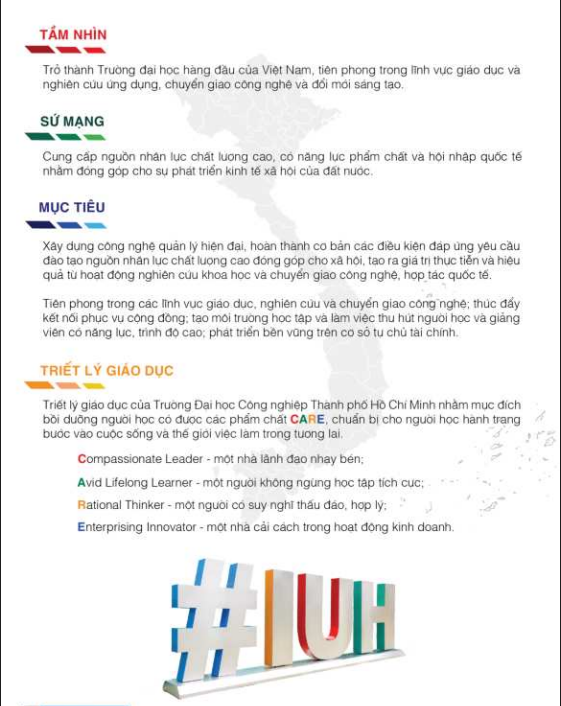
IUH Student Handbook cover
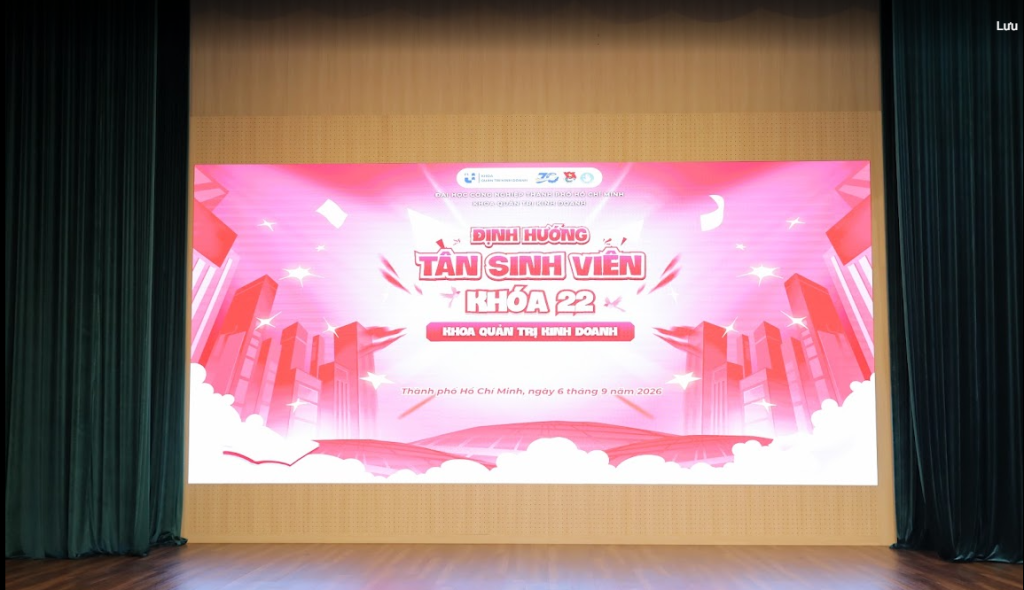
New Student Orientation session for the Faculty of Business Administration)
Source:
https://www.facebook.com/share/p/14vf9hbwWp7/
Activity 2: Systematically Mapping SDGs into Program Learning Outcomes Across Academic Disciplines
To ensure that sustainability education is embedded across the entire university rather than restricted to environmental majors, IUH systematically maps SDG targets into the Program Learning Outcomes (PLOs) and educational objectives across all faculties. In Economics and Management, programs such as Business Administration and E-Commerce emphasize business ethics, corporate social responsibility, and digital adaptation, directly supporting SDG 4 (Quality Education) and SDG 8 (Decent Work and Economic Growth). In Chemical, Biological, Food, and Environmental Sciences, curricula focus on resource efficiency, ecosystem preservation, and environmental management, aligned with SDG 6, SDG 12, SDG 13, and SDG 15. In Engineering and Technology, programs embed scientific innovation and renewable energy solutions, contributing to SDG 7 and SDG 9. This mapping guarantees that every student fulfills mandatory sustainability competencies prior to graduation.
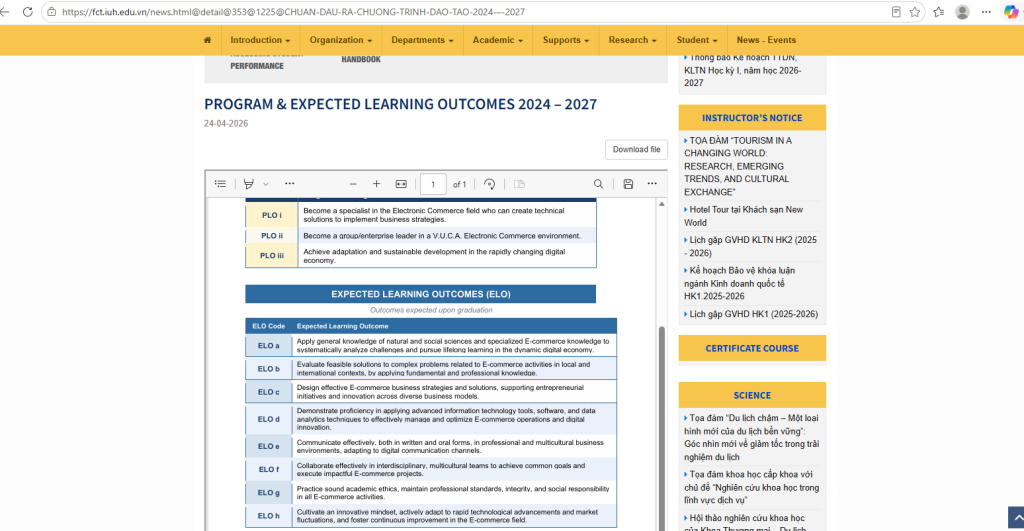
E-commerce Program Objectives and Learning Outcomes (2024)
Source:
PROGRAM & EXPECTED LEARNING OUTCOMES 2024 – 2027
Marketing Expected learning outcomes 2026 – Faculty of Business Administration
Undergraduate Biotechnology – Introduction – Institute of Biotechnology and Food Technology
Institute of Environmental Science, Engineering and Management
Activity 3: Broadening Interdisciplinary Sustainability Learning via International Projects and Academic Forums
IUH expands learning opportunities beyond traditional classrooms by offering interdisciplinary sustainability projects and global academic conferences open to all majors. Co-organized with the Eurasia Foundation, the international project “Connecting Knowledge – Building an Asian Youth Community for Sustainable Development between People and the Environment” provides equal access for students across all faculties to participate in 15 specialized modules integrated into the Environment and Human course. Taught by local and international experts, topics cover nature conservation, climate change, renewable energy, and the circular economy, awarding international certificates upon completion. Additionally, IUH organized the 3rd International Conference on Advanced Technology and Sustainable Development (ICATSD 2026) on October 8–10, 2026, serving as a global academic forum where students and faculty engage directly with cutting-edge research and real-world industrial applications for sustainability.
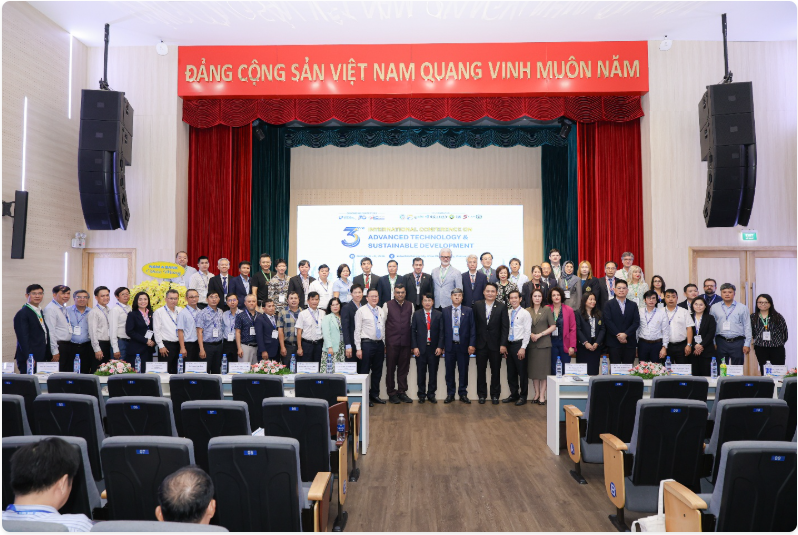
The 3rd International Conference on Advanced Technology and Sustainable Development (ICATSD 2026)
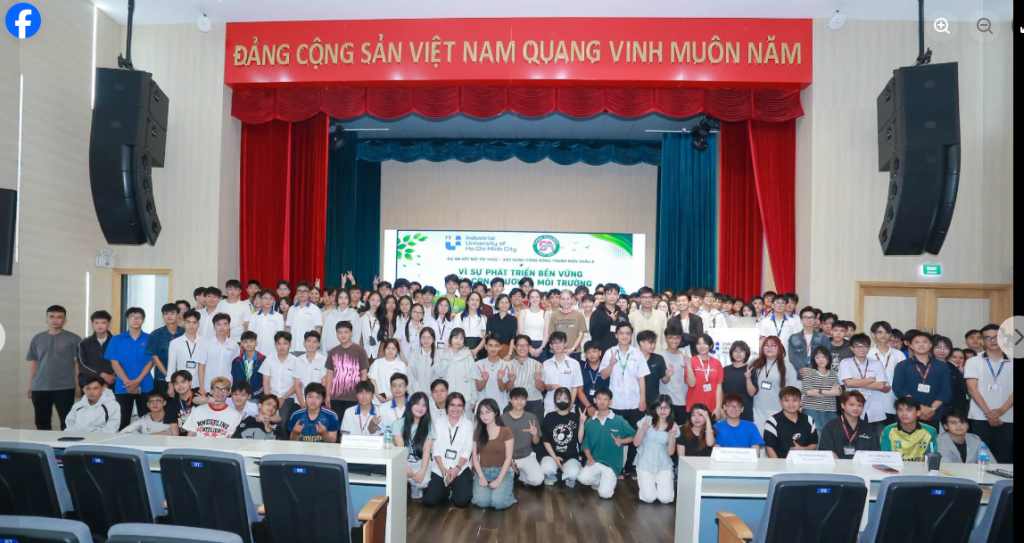
The International Project “Connecting Knowledge – Building an Asian Youth Community for Sustainable Development between People and the Environment” at IUH
Source:
https://www.facebook.com/share/p/19psK65s3m/
Activity 4: Fostering Green Innovation and Entrepreneurship Through University-Wide Competitions
To translate sustainability knowledge into practical solutions, IUH encourages green innovation through university-wide student competitions organized by the Center for Innovation, Entrepreneurship and Technology Transfer. On May 31, 2025, the final round of the Innogreen Life 2024 competition featured 10 outstanding student projects selected from nearly 70 proposals across five fields: green technology, environmental protection, renewable energy, education, and social governance. The competition provided over VND 1.2 billion in total prize value, scholarships, project incubation, media support, and expert mentoring. This platform enables students across all faculties to test eco-friendly ideas, collaborate with industry mentors, and develop entrepreneurial skills that address pressing environmental and social challenges.
Final Round of the 4th Season of the Innogreen Life 2024 Green Innovation and Entrepreneurship
Source:
https://tuoitre.vn/khoahocphothong/sinh-vien-iuh-thap-lua-sang-tao-vi-cuoc-song-xanh-104259983.htm
Results and Impact
During the reporting period, IUH achieved comprehensive outputs across its academic ecosystem by delivering mandatory SDG-aligned orientation materials to 100% of newly admitted freshmen, publishing official PLO mappings across all academic faculties on its public web portal, and delivering 15 international specialized modules under the Eurasia Foundation partnership. Furthermore, the Innogreen Life 2024 competition successfully engaged nearly 70 project teams, advancing 10 finalist proposals with over VND 1.2 billion in combined awards and incubation support, while the ICATSD 2026 conference convened international researchers, faculty, and students to advance sustainable technology applications.
These outputs deliver direct, meaningful outcomes and long-term impacts by ensuring that sustainability education is systematically embedded into the learning journey of every IUH student rather than restricted to a few specialized majors. Students reduce their barriers to interdisciplinary knowledge, gain international certification, and acquire critical capabilities in ethical reasoning, green innovation, and social responsibility. Ultimately, this university-wide integration equips 100% of graduates with the skills required to drive transformative contributions toward SDG 4 (Quality Education), SDG 8 (Decent Work and Economic Growth), SDG 9 (Industry, Innovation and Infrastructure), SDG 12 (Responsible Consumption and Production), SDG 13 (Climate Action), and SDG 17 (Partnerships for the Goals).
Cam kết chiến lược của iuh về giáo dục sdgs đưa vào chương trình đào tạo và mở rộng cơ hội tiếp cận cho sinh viên toàn trường
Nằm trong chiến lược cấp trường về thúc đẩy phát triển bền vững, Trường Đại học Công nghiệp Thành phố Hồ Chí Minh (IUH) khẳng định cam kết mạnh mẽ trong việc cung cấp giáo dục có ý nghĩa, phù hợp và có thể tiếp cận đối với 100% sinh viên về các Mục tiêu Phát triển Bền vững (SDGs) của Liên Hợp Quốc. Được định hướng bởi các giá trị cốt lõi “Đổi mới – Đoàn kết – Nhân văn” cùng Triết lý giáo dục CARE, IUH giải quyết thách thức chuyển dịch giáo dục bền vững từ các môn học tự chọn riêng lẻ thành yêu cầu mang tính hệ thống cấp trường. Bằng cách lồng ghép nhất quán SDGs vào tài liệu định hướng bắt buộc, Sổ tay Sinh viên, Chuẩn đầu ra (PLOs) của tất cả các ngành đào tạo, dự án liên ngành và sân chơi đổi mới sáng tạo, IUH đảm bảo mọi người học đều được trang bị đầy đủ tri thức, đạo đức nghề nghiệp và năng lực giải quyết các thách thức toàn cầu.
Hoạt động 1: Lồng ghép phát triển bền vững và giá trị cốt lõi vào Sổ tay sinh viên và chương trình định hướng bắt buộc
Ngay từ khi nhập học, 100% tân sinh viên IUH đều được tiếp cận có hệ thống với các nguyên tắc phát triển bền vững và cam kết của nhà trường thông qua các tài liệu định hướng chính thức. Trong Sổ tay Sinh viên – tài liệu định hướng chính thức ban hành cho 100% người học khi nhập học, Trường Đại học Công nghiệp TP.HCM (IUH) khẳng định mục tiêu chiến lược là “thúc đẩy kết nối phục vụ cộng đồng” và “phát triển bền vững”. Cam kết cấp trường này được lan tỏa trực tiếp đến toàn thể sinh viên thông qua Triết lý giáo dục CARE, hướng tới đào tạo những thế hệ người học hội tụ đầy đủ các phẩm chất cốt lõi: Nhà lãnh đạo nhạy bén, giàu lòng trắc ẩn (Compassionate Leader); Người học tập suốt đời tích cực (Avid Lifelong Learner); Người có tư duy thấu đáo, hợp lý (Rational Thinker); và Nhà cải cách đổi mới sáng tạo (Enterprising Innovator). Vào đầu mỗi năm học, các buổi định hướng tân sinh viên tại tất cả các khoa (như Khoa Quản trị Kinh doanh) đều lồng ghép nội dung phát triển bền vững, nâng cao nhận thức về trách nhiệm xã hội, đạo đức nghề nghiệp, tinh thần học tập suốt đời và nguyên tắc kinh doanh bền vững.
Nguồn minh chứng:
https://tqa.iuh.edu.vn/wp-content/uploads/2024/09/So-tay-sinh-vien-IUH-2024-2.pdf
https://www.facebook.com/share/p/14vf9hbwWp7/
Hoạt động 2: Hệ thống hóa việc tích hợp SDGs vào Chuẩn đầu ra và chương trình đào tạo đa ngành
Để đảm bảo giáo dục phát triển bền vững được đưa vào toàn trường chứ không chỉ xuất hiện rải rác ở một vài ngành môi trường, IUH đưa các tiêu chí SDGs vào Chuẩn đầu ra (PLOs) và mục tiêu đào tạo của tất cả các khoa. Ở khối ngành Kinh tế và Quản trị, các chương trình như Quản trị Kinh doanh và Thương mại Điện tử chú trọng đạo đức kinh doanh, trách nhiệm xã hội và thích ứng kinh tế số, gắn liền với SDG 4 (Giáo dục có chất lượng) và SDG 8 (Tăng trưởng kinh tế và việc làm bền vững). Ở khối ngành Hóa học, Sinh học, Thực phẩm và Môi trường, chương trình tập trung vào sử dụng hiệu quả tài nguyên, bảo tồn hệ sinh thái và quản lý môi trường, đóng góp cho SDG 6, SDG 12, SDG 13 và SDG 15. Ở khối Kỹ thuật và Công nghệ, các ngành học lồng ghép ứng dụng khoa học và giải pháp năng lượng tái tạo, đóng góp cho SDG 7 và SDG 9. Việc chuẩn hóa này đảm bảo sinh viên mọi ngành đều hoàn thành các năng lực bền vững bắt buộc trước khi tốt nghiệp.
Nguồn minh chứng:
PROGRAM & EXPECTED LEARNING OUTCOMES 2024 – 2027
Marketing Expected learning outcomes 2026 – Faculty of Business Administration
Undergraduate Biotechnology – Introduction – Institute of Biotechnology and Food Technology
Institute of Environmental Science, Engineering and Management
Hoạt động 3: Mở rộng cơ hội học tập phát triển bền vững liên ngành qua dự án hợp tác quốc tế và diễn đàn khoa học
IUH mở rộng không gian học tập vượt ra ngoài giảng đường truyền thống thông qua các dự án phát triển bền vững liên ngành và hội nghị khoa học quốc tế dành cho sinh viên tất cả các ngành. Phối hợp cùng Quỹ Eurasia, dự án quốc tế “Kết nối tri thức – Xây dựng cộng đồng thanh niên châu Á vì sự phát triển bền vững giữa con người và môi trường” tạo cơ hội học tập bình đẳng cho sinh viên toàn trường tham gia 15 chuyên đề tích hợp trong môn học Môi trường và Con người. Do các chuyên gia trong và ngoài nước giảng dạy, dự án tập trung vào bảo tồn thiên nhiên, biến đổi khí hậu, năng lượng tái tạo và kinh tế tuần hoàn, cấp chứng nhận quốc tế sau khi hoàn thành. Bên cạnh đó, IUH tổ chức Hội nghị Quốc tế ICATSD 2026 từ ngày 08-10/10/2026, tạo diễn đàn học thuật toàn cầu để sinh viên và giảng viên tiếp cận các nghiên cứu tiên phong và ứng dụng thực tiễn vì sự phát triển bền vững.
Nguồn minh chứng:
https://www.facebook.com/share/p/19psK65s3m/
Hoạt động 4: Thúc đẩy đổi mới sáng tạo xanh và tinh thần khởi nghiệp qua các cuộc thi quy mô toàn trường
Nhằm hiện thực hóa tri thức phát triển bền vững thành giải pháp thực tiễn, IUH khuyến khích tư duy đổi mới sáng tạo xanh thông qua cuộc thi khởi nghiệp sinh viên do Trung tâm Đổi mới sáng tạo, Khởi nghiệp và Chuyển giao công nghệ tổ chức. Ngày 31/05/2025, chung kết cuộc thi Innogreen Life 2024 diễn ra với 10 dự án xuất sắc được tuyển chọn từ gần 70 đề án thuộc 5 lĩnh vực: công nghệ xanh, môi trường, năng lượng tái tạo, giáo dục và quản trị xã hội. Cuộc thi đã mang lại tổng giá trị giải thưởng và hỗ trợ vượt 1,2 tỷ đồng bao gồm tiền mặt, học bổng, ươm tạo dự án, truyền thông và cố vấn chuyên sâu. Sân chơi này giúp sinh viên tất cả các khoa thử nghiệm ý tưởng sinh thái, hợp tác với chuyên gia và phát triển năng lực khởi nghiệp giải quyết các vấn đề môi trường – xã hội.
Nguồn minh chứng:
https://tuoitre.vn/khoahocphothong/sinh-vien-iuh-thap-lua-sang-tao-vi-cuoc-song-xanh-104259983.htm
Kết quả và tác động
Trong kỳ báo cáo, IUH đã đạt được các kết quả đầu ra định lượng toàn diện bao gồm: phổ biến tài liệu định hướng lồng ghép SDGs đến 100% tân sinh viên; công khai ma trận tích hợp SDGs vào Chuẩn đầu ra (PLOs) của các ngành đào tạo trên website chính thức; triển khai 15 chuyên đề học thuật quốc tế thuộc dự án hợp tác với Quỹ Eurasia. Đồng thời, cuộc thi Innogreen Life 2024 thu hút gần 70 dự án tham gia, trao hỗ trợ ươm tạo và giải thưởng hơn 1,2 tỷ đồng cho 10 dự án chung kết, cùng việc tổ chức thành công Hội nghị Quốc tế ICATSD 2026 kết nối đông đảo các nhà khoa học, giảng viên và người học.
Những kết quả này mang lại lợi ích trực tiếp và tác động lâu dài khi chứng minh giáo dục SDGs tại IUH được đưa vào có hệ thống vào lộ trình học tập của mọi sinh viên, thay vì chỉ xuất hiện ở một vài ngành chuyên biệt. Sinh viên giảm rào cản tiếp cận tri thức liên ngành, nhận chứng chỉ quốc tế và được trang bị năng lực tư duy phản biện, đổi mới xanh cùng trách nhiệm xã hội. Qua đó, 100% sinh viên tốt nghiệp sở hữu nền tảng vững chắc để đóng góp thực chất vào việc thực hiện SDG 4 (Giáo dục có chất lượng), SDG 8 (Việc làm bền vững và tăng trưởng kinh tế), SDG 9 (Công nghiệp, Đổi mới và Cơ sở hạ tầng), SDG 12 (Tiêu dùng và sản xuất có trách nhiệm), SDG 13 (Hành động vì khí hậu) và SDG 17 (Hợp tác vì các mục tiêu).


