
Effective wastewater management is essential for protecting natural ecosystems, preventing environmental contamination and maintaining safe conditions in educational and research facilities. University laboratories may generate spent chemical solutions, solvents and biological waste materials that require appropriate handling to avoid adverse effects on water quality, soil and human health.
Industrial University of Ho Chi Minh City (IUH) addresses these environmental risks through laboratory waste management procedures, safety regulations and arrangements for transferring hazardous waste to an external treatment service provider.
The supporting documentation identifies three related approaches: classification and separate collection of hazardous liquid waste, laboratory rules preventing direct chemical discharge into drainage systems, and a framework contract covering the collection, transportation and treatment of hazardous waste.
These arrangements contribute to Sustainable Development Goal 15 (SDG 15) – Life on Land by supporting the prevention of pollution that could affect terrestrial ecosystems. They also have complementary relevance to SDG 6 – Clean Water and Sanitation.
Activity 1: Classifying, Collecting and Storing Hazardous Laboratory Liquid Waste
The effective control of laboratory wastewater begins with identifying potentially hazardous substances and preventing their uncontrolled release into drainage networks.
According to IUH’s supporting dossier, laboratory and practical teaching facilities associated with the Faculty of Chemical Engineering and the Institute for Environmental Science, Engineering and Management (IESEM) apply waste management procedures covering chemical and other hazardous waste streams.
The procedures address spent laboratory solutions, used solvents, acids, alkalis, heavy-metal-containing substances and liquids containing potentially hazardous components.
The supporting documentation identifies the following hazardous waste codes: 020106, 020202, 020302, 170803 and 191001.
Under the described approach, hazardous liquid wastes are collected separately, classified according to their relevant waste categories and stored in appropriate sealed and labelled containers.
The identification and separation of waste streams help support safer handling, temporary storage and subsequent transfer for treatment.
These arrangements are particularly relevant to laboratories used by students, lecturers, researchers and technical personnel, where different types of chemicals may be generated during teaching and experimental activities.
Proper segregation also helps reduce the likelihood of mixing incompatible substances and supports the traceability of waste from generation to subsequent management.
The dossier describes the transfer of hazardous laboratory waste to an external service provider rather than its direct disposal through ordinary drainage systems.
This source-control approach is relevant to protecting campus drainage infrastructure and reducing the risk of hazardous substances entering receiving waters and surrounding ecosystems.
For laboratory users, defined collection and storage arrangements support safer working practices and environmental responsibility.
For institutional management, waste classification and labelling provide a basis for maintaining inventories and checking compliance with applicable waste management procedures.
However, the current dossier does not include the complete approved waste management procedure, detailed records of hazardous liquid waste quantities or evidence confirming the application of all identified waste codes to specific waste streams.
It also does not provide monitoring results demonstrating that environmental contamination was completely prevented.
The documented contribution is therefore the existence of described waste classification, collection and storage arrangements requiring further verification through operational records.
Through these practices, IUH supports the management of hazardous laboratory liquid waste and the prevention of potential impacts on water resources and terrestrial ecosystems.
Evidence source:
Waste Management Procedure – Faculty of Chemical Engineering and IESEM, referenced in the supporting dossier.
A direct public evidence URL has not yet been provided.
Activity 2: Applying Laboratory Safety Rules to Prevent Chemical Discharge into Drainage Systems
Laboratory safety rules are an important part of environmental management because improper chemical disposal may contaminate drainage infrastructure and surrounding environments.
According to the supporting documentation, IUH’s laboratory rules prohibit the direct disposal of chemical solutions, used solvents and hazardous liquid waste into ordinary drainage systems.
The procedures described for the Faculty of Chemical Engineering and other relevant laboratories also address the handling of biological materials and responses to accidental spills.
The dossier states that microbial samples requiring decontamination are subjected to sterilization using an autoclave before disposal in accordance with laboratory procedures.
In the event of a chemical spill or biological contamination incident, laboratory personnel are required to initiate appropriate response measures.
These include the use of suitable absorbent materials, decontamination where necessary and the collection of resulting waste into designated containers.
Such measures aim to limit the uncontrolled spread of hazardous materials and reduce potential exposure to laboratory users and the environment.
The dossier also describes checking and recording chemical and equipment handovers after laboratory sessions.
These records can help lecturers and technical personnel account for materials used during practical activities and identify issues requiring further attention.
The use of laboratory rules and spill response arrangements supports an institutional approach to reducing pollution risks at source.
For students and staff, compliance with these requirements contributes to the development of safe laboratory practices.
For environmental management, preventing hazardous substances from entering ordinary drains reduces one potential pathway through which pollutants could reach receiving waters.
However, the supporting file does not include complete dated copies of the laboratory rules, inspection logs, training attendance records or incident response reports.
It is therefore not possible to quantify compliance rates or establish that no prohibited discharge incidents occurred during 2025.
The available evidence describes preventive controls and operational responsibilities, rather than independently verified environmental performance.
Through laboratory safety and waste management procedures, IUH supports pollution prevention and responsible management of teaching and research activities.
Evidence source:
Laboratory Rules and Chemical Spill Response Procedures – Faculty of Chemical Engineering, referenced in the supporting dossier.
A direct public evidence URL has not yet been provided.
Activity 3: Arranging Hazardous Waste Collection and Treatment through an External Environmental Service Provider
The transfer of hazardous laboratory waste to an appropriately authorized service provider is an important component of responsible environmental management.
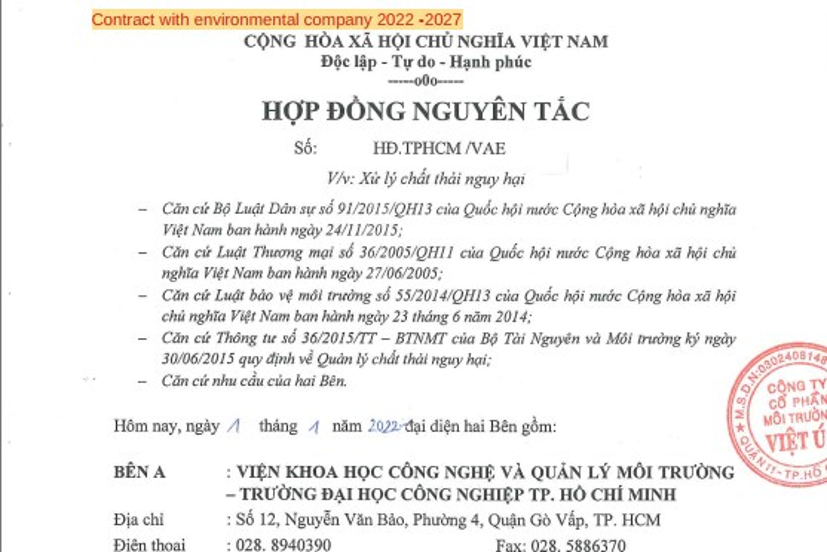
The supporting documentation includes a framework contract, identified as No. HĐ.TPHCM/VAE, between IESEM–IUH and Viet Uc Environment Joint Stock Company.
The dossier describes the contractor’s treatment facility as being located in Le Minh Xuan Industrial Park, Binh Chanh, Ho Chi Minh City.
The framework agreement concerns the collection, transportation and treatment of hazardous waste generated within the agreed scope.
According to the supporting narrative, the contract was established in January 2022 for a five-year period. The precise signing date and contractual end date require confirmation against the complete signed agreement.
The document describes periodic waste collection and the return of hazardous waste tracking documents to IUH for institutional monitoring.
It also refers to the provision of waste documentation within 15 days, although this requirement should be verified against the applicable contractual terms and supporting records.
The arrangement provides a mechanism for transferring hazardous waste from laboratory facilities to a specialized external provider.
For IUH, the contract forms part of the documented waste management framework and provides a basis for identifying responsibilities related to collection, transportation, treatment and recordkeeping.
For laboratory operations, periodic collection can help manage accumulated hazardous waste and maintain an organized system for its temporary storage.
The availability of waste transfer documentation is particularly important for establishing traceability and confirming that waste has been handed over to the relevant service provider.
The supporting dossier includes an image of the first page of the framework contract.
However, the current documentation does not include the contractor’s applicable authorization details, complete contractual provisions, individual waste transfer manifests or treatment certificates for 2025.
Consequently, the available evidence establishes the existence of a framework contracting arrangement but does not independently verify the quantities of hazardous waste collected and treated during the reporting year.
It also does not demonstrate compliance of IUH’s wastewater discharged through its drainage or treatment systems with environmental quality standards.
Further records are needed to distinguish the off-site treatment of collected hazardous liquids from the treatment and discharge of conventional campus wastewater.
Through its documented waste management arrangements, IUH supports responsible hazardous waste handling and the development of a traceable environmental management process.
Evidence source:
Framework Contract No. HĐ.TPHCM/VAE with Viet Uc Environment Joint Stock Company, reproduced in the supporting dossier.
The original signed contract, contract validity and waste transfer records require verification. No direct public evidence URL was provided.
Results and Impact
IUH’s supporting documentation identifies three related measures for managing potentially hazardous laboratory liquid waste.
First, laboratory waste management procedures describe the classification, segregation and labelled storage of hazardous chemical liquids and other waste streams. Second, laboratory safety rules prohibit direct disposal of hazardous chemicals into ordinary drainage systems and provide requirements for handling biological materials and responding to spills. Third, a framework agreement with an external environmental service provider establishes arrangements for hazardous waste collection, transportation and treatment.
Together, these measures represent a source-control approach designed to reduce environmental risks associated with teaching and research laboratories.
The arrangements can help limit improper disposal, improve hazardous waste traceability and support safer laboratory operations.
Their relevance to SDG 15 lies in preventing potentially harmful substances from entering environments connected to terrestrial ecosystems, with additional relevance to water quality protection under SDG 6.
However, the currently available documentation does not provide verified quantities of hazardous liquid waste collected and treated during 2025, results of wastewater discharge monitoring, or confirmation of compliance with applicable effluent standards.
Therefore, the dossier demonstrates a documented approach to hazardous laboratory waste management, while direct compliance with water discharge quality requirements under Indicator 15.4.1 remains to be substantiated.
IUH tăng cường kiểm soát nước thải và chất thải lỏng nguy hại tại phòng thí nghiệm nhằm bảo vệ môi trường và hệ sinh thái
Kiểm soát nước thải và chất thải lỏng nguy hại là một trong những yêu cầu quan trọng đối với công tác bảo vệ môi trường tại các cơ sở giáo dục đại học. Trong hoạt động đào tạo, nghiên cứu và thực hành, phòng thí nghiệm có thể phát sinh dung dịch hóa chất, dung môi đã qua sử dụng và chất thải sinh học. Nếu không được thu gom, lưu chứa và xử lý phù hợp, những chất thải này có nguy cơ ảnh hưởng đến nguồn nước, đất và sức khỏe con người.
Trường Đại học Công nghiệp Thành phố Hồ Chí Minh (IUH) thực hiện các biện pháp quản lý chất thải phòng thí nghiệm thông qua quy trình phân loại, thu gom chất thải, nội quy an toàn và cơ chế chuyển giao chất thải nguy hại cho đơn vị xử lý bên ngoài.
Hồ sơ của Nhà trường ghi nhận ba nhóm hoạt động: quản lý chất thải lỏng theo mã chất thải nguy hại, ngăn ngừa việc xả trực tiếp hóa chất vào hệ thống thoát nước và tổ chức thu gom, vận chuyển, xử lý chất thải thông qua hợp đồng với đơn vị chuyên môn.
Những hoạt động này có liên quan đến Mục tiêu phát triển bền vững số 15 (SDG 15) – Hệ sinh thái trên cạn, thông qua phòng ngừa nguy cơ ô nhiễm môi trường. Đồng thời, các biện pháp có ý nghĩa bổ trợ đối với SDG 6 – Nước sạch và vệ sinh.
Hoạt động 1: Thực hiện quy trình phân loại, thu gom và lưu chứa chất thải lỏng nguy hại tại phòng thí nghiệm
Hoạt động kiểm soát chất thải tại nguồn có vai trò quan trọng trong việc hạn chế nguy cơ hóa chất nguy hại đi vào hệ thống thoát nước và môi trường tự nhiên.
Theo hồ sơ tổng hợp, các phòng thí nghiệm và phòng thực hành thuộc Khoa Công nghệ Hóa học và Viện Khoa học Công nghệ và Quản lý Môi trường (IESEM) thực hiện quy trình quản lý chất thải phát sinh trong quá trình giảng dạy, nghiên cứu và thực nghiệm.
Những nhóm chất thải được đề cập gồm dung dịch hóa chất sau sử dụng, dung môi, axit, kiềm, hợp chất chứa kim loại nặng và các loại chất lỏng có thành phần nguy hại.
Hồ sơ ghi nhận các mã chất thải nguy hại gồm 020106, 020202, 020302, 170803 và 191001. Việc áp dụng mã cụ thể cần được đối chiếu với tính chất chất thải và danh mục quản lý có hiệu lực.
Theo quy trình được mô tả, chất thải lỏng nguy hại được thu gom riêng, phân loại và lưu chứa trong những thùng chuyên dụng có nắp kín, gắn nhãn nhận diện.
Việc phân loại tại nguồn giúp hỗ trợ quản lý từng nhóm chất thải, hạn chế nguy cơ trộn lẫn các hóa chất không tương thích và tạo thuận lợi cho việc chuyển giao xử lý.
Đối với sinh viên, giảng viên và kỹ thuật viên, các yêu cầu về thu gom và lưu chứa góp phần hình thành thói quen thực hành có trách nhiệm đối với an toàn phòng thí nghiệm và bảo vệ môi trường.
Đối với công tác quản lý, việc nhận diện chất thải bằng mã và nhãn là cơ sở để kiểm soát nguồn phát sinh, vị trí lưu giữ và hồ sơ bàn giao.
Hồ sơ mô tả việc chuyển giao những chất thải nguy hại cần xử lý cho đơn vị chuyên môn thay vì xả trực tiếp qua hệ thống thoát nước thông thường.
Đây là biện pháp phòng ngừa có ý nghĩa đối với việc hạn chế nguy cơ hóa chất đi vào nguồn nước tiếp nhận và các hệ sinh thái có liên quan.
Tuy nhiên, tài liệu hiện chưa đính kèm đầy đủ quy trình đã được phê duyệt, danh mục lượng chất thải lỏng phát sinh và hồ sơ vận hành cụ thể trong năm 2025.
Do đó, chưa có cơ sở xác nhận toàn bộ chất thải lỏng nguy hại đều đã được thu gom đúng quy trình trong kỳ báo cáo.
Giá trị trực tiếp của hoạt động là việc xây dựng và mô tả cơ chế phân loại, thu gom, lưu chứa chất thải tại phòng thí nghiệm, cần tiếp tục được chứng minh qua tài liệu vận hành thực tế.
Thông qua các biện pháp kiểm soát tại nguồn, IUH hướng đến giảm thiểu nguy cơ ô nhiễm phát sinh từ hoạt động giảng dạy và nghiên cứu, góp phần bảo vệ môi trường theo định hướng SDG 15.
Nguồn minh chứng:
Quy trình quản lý chất thải của Khoa Công nghệ Hóa học và Viện Khoa học Công nghệ và Quản lý Môi trường.
Hồ sơ chưa cung cấp URL công khai trực tiếp; cần bổ sung bản quy trình có ngày ban hành và xác nhận của đơn vị quản lý.
Hoạt động 2: Áp dụng nội quy phòng thí nghiệm nhằm ngăn ngừa xả hóa chất nguy hại vào hệ thống thoát nước
Quản lý hóa chất trong phòng thí nghiệm không chỉ liên quan đến an toàn của người sử dụng mà còn có ý nghĩa trong phòng ngừa ô nhiễm nguồn nước và môi trường xung quanh.
Theo hồ sơ IUH, nội quy phòng thực hành quy định không xả trực tiếp dung dịch hóa chất, dung môi đã qua sử dụng và chất thải nguy hại vào hệ thống thoát nước thông thường.
Quy định nhằm kiểm soát những rủi ro phát sinh từ việc xử lý hóa chất không đúng phương pháp trong quá trình thực hành và nghiên cứu.
Đối với mẫu vi sinh có yêu cầu khử nhiễm, hồ sơ mô tả việc sử dụng thiết bị hấp tiệt trùng (autoclave) trước khi thực hiện các bước xử lý tiếp theo theo quy trình.
Trong trường hợp xảy ra sự cố tràn đổ hóa chất hoặc phát tán vật liệu sinh học, người phụ trách phòng thí nghiệm thực hiện biện pháp ứng phó phù hợp, gồm cô lập khu vực, sử dụng vật liệu hấp phụ thích hợp, khử nhiễm khi cần thiết và thu gom chất thải phát sinh vào dụng cụ chứa quy định.
Những biện pháp này hướng đến việc hạn chế sự lan truyền của chất nguy hại và giảm nguy cơ tiếp xúc đối với người sử dụng phòng thí nghiệm.
Hồ sơ cũng đề cập đến hoạt động kiểm tra, ghi nhận việc bàn giao hóa chất và thiết bị sau mỗi buổi thực hành.
Thông tin ghi nhận có thể hỗ trợ giảng viên, kỹ thuật viên kiểm soát vật tư, theo dõi hoạt động sử dụng hóa chất và phát hiện những vấn đề cần xử lý.
Việc kết hợp nội quy an toàn với quy trình ứng phó sự cố góp phần tạo nền tảng quản lý rủi ro môi trường tại các phòng thí nghiệm.
Đối với sinh viên, việc tuân thủ nội quy giúp nâng cao ý thức trách nhiệm và kỹ năng thực hành an toàn.
Đối với Nhà trường, quy trình phòng ngừa xả thải góp phần hạn chế một trong những nguy cơ gây ô nhiễm hệ thống thoát nước và nguồn tiếp nhận.
Tuy nhiên, hồ sơ chưa kèm đầy đủ bản nội quy có xác nhận, sổ kiểm tra thực hiện, tài liệu tập huấn và biên bản xử lý sự cố trong năm 2025.
Vì vậy, chưa có căn cứ để khẳng định tỷ lệ tuân thủ đạt mức cụ thể hoặc không xảy ra trường hợp xả thải không đúng quy định.
Hoạt động thể hiện những yêu cầu kiểm soát và phòng ngừa rủi ro tại phòng thí nghiệm, đồng thời cần được đối chiếu với kết quả kiểm tra vận hành để xác định hiệu quả.
Thông qua việc áp dụng nội quy và hướng dẫn an toàn, IUH góp phần thúc đẩy trách nhiệm bảo vệ môi trường trong đào tạo, nghiên cứu và thực hành khoa học.
Nguồn minh chứng:
Nội quy phòng thực hành, quy trình quản lý chất thải và phương án ứng phó sự cố thuộc Khoa Công nghệ Hóa học.
Chưa có URL công khai trực tiếp; cần bổ sung tài liệu được ban hành hoặc xác nhận chính thức.
Hoạt động 3: Tổ chức thu gom và xử lý chất thải nguy hại thông qua hợp đồng với Công ty Cổ phần Môi trường Việt Úc
Bên cạnh hoạt động phân loại và lưu chứa tại nguồn, việc chuyển giao chất thải nguy hại cho đơn vị đủ điều kiện thực hiện dịch vụ là một thành phần quan trọng trong hệ thống quản lý môi trường.
Hồ sơ của IUH có hình ảnh Hợp đồng nguyên tắc số HĐ.TPHCM/VAE giữa Viện Khoa học Công nghệ và Quản lý Môi trường với Công ty Cổ phần Môi trường Việt Úc.
Theo tài liệu, đối tác có cơ sở xử lý tại Khu công nghiệp Lê Minh Xuân, Bình Chánh, Thành phố Hồ Chí Minh.
Nội dung hợp đồng được mô tả liên quan đến hoạt động thu gom, vận chuyển và xử lý chất thải nguy hại thuộc phạm vi thỏa thuận giữa các bên.
Hồ sơ cho biết hợp đồng được thiết lập trong tháng 01/2022, với thời hạn năm năm. Ngày ký và ngày kết thúc hiệu lực cần được kiểm tra từ toàn văn bản hợp đồng gốc.
Theo mô tả trong hồ sơ, hoạt động thu gom được thực hiện định kỳ và có chứng từ chuyển giao chất thải để Nhà trường lưu trữ, phục vụ theo dõi.
Tài liệu cũng đề cập yêu cầu chuyển chứng từ trong vòng 15 ngày; nội dung này cần được xác minh bằng điều khoản hợp đồng và các hồ sơ thực hiện tương ứng.
Việc có hợp đồng với đơn vị thu gom, xử lý tạo cơ sở xác định trách nhiệm giữa bên phát sinh và bên tiếp nhận chất thải.
Đối với Nhà trường, hồ sơ chuyển giao có ý nghĩa trong theo dõi quá trình đưa chất thải nguy hại ra khỏi khu vực lưu chứa và tổ chức xử lý.
Đối với hoạt động phòng thí nghiệm, công tác thu gom định kỳ hỗ trợ kiểm soát lượng chất thải tích lũy và điều kiện lưu giữ.
Hồ sơ hợp đồng cũng là một thành phần phục vụ kiểm tra việc tuân thủ các yêu cầu quản lý chất thải của đơn vị phát sinh.
Tuy nhiên, tài liệu hiện mới cung cấp hình ảnh trang đầu hợp đồng nguyên tắc, chưa có các chứng từ chuyển giao cụ thể, kết quả xử lý và xác minh tình trạng giấy phép của đơn vị cung cấp dịch vụ trong năm 2025.
Do đó, hợp đồng là căn cứ về cơ chế tổ chức hoạt động quản lý chất thải, chưa đủ để khẳng định số lượng chất thải thực tế đã được thu gom, xử lý đúng quy định trong kỳ báo cáo.
Cũng cần phân biệt hoạt động chuyển giao chất thải lỏng nguy hại để xử lý bên ngoài với việc xử lý và xả nước thải thông thường từ hệ thống xử lý nước thải của Nhà trường.
Để chứng minh việc đáp ứng tiêu chuẩn nước xả, cần có dữ liệu quan trắc riêng tại các điểm xả thải theo yêu cầu áp dụng.
Thông qua cơ chế hợp đồng dịch vụ và theo dõi chứng từ, IUH tăng cường nền tảng quản lý chất thải nguy hại, hướng đến bảo vệ nguồn nước và hạn chế tác động đến hệ sinh thái tự nhiên.
Nguồn minh chứng:
Hợp đồng nguyên tắc số HĐ.TPHCM/VAE với Công ty Cổ phần Môi trường Việt Úc được đính kèm trong hồ sơ IUH.
Chưa có URL công khai trực tiếp cho bản hợp đồng; cần xác minh các thông tin liên quan trước khi công bố.
Kết quả và tác động
Hồ sơ IUH ghi nhận ba nhóm biện pháp liên quan đến quản lý chất thải lỏng nguy hại tại phòng thí nghiệm.
Thứ nhất, quy trình quản lý chất thải mô tả việc phân loại, thu gom và lưu chứa riêng các dung dịch hóa chất, dung môi và chất thải có thành phần nguy hại. Thứ hai, nội quy phòng thí nghiệm quy định không xả hóa chất nguy hại trực tiếp vào hệ thống thoát nước, đồng thời xác định các bước xử lý vật liệu sinh học và ứng phó sự cố tràn đổ. Thứ ba, hợp đồng nguyên tắc với Công ty Cổ phần Môi trường Việt Úc tạo cơ sở tổ chức hoạt động chuyển giao chất thải nguy hại cho đơn vị xử lý bên ngoài.
Các biện pháp này thể hiện định hướng kiểm soát ô nhiễm ngay tại nguồn phát sinh, tăng cường quản lý chất thải nguy hại và phòng ngừa rủi ro ảnh hưởng đến nguồn nước, đất và môi trường sống.
Những nội dung này phù hợp với SDG 15 về bảo vệ hệ sinh thái trên cạn, đồng thời hỗ trợ SDG 6 về bảo vệ nguồn nước.
Tuy nhiên, hồ sơ hiện chưa cung cấp số liệu xác minh khối lượng chất thải lỏng nguy hại đã chuyển giao trong năm 2025, kết quả quan trắc nước thải đầu ra hoặc bằng chứng cho thấy những điểm xả thải liên quan đáp ứng đầy đủ giới hạn chất lượng môi trường áp dụng.
Vì vậy, kết quả có cơ sở hiện tại là hệ thống biện pháp kiểm soát chất thải phòng thí nghiệm được mô tả trong tài liệu. Để chứng minh trực tiếp tiêu chí 15.4.1, cần bổ sung hồ sơ kiểm soát chất lượng nước xả, kết quả quan trắc và tài liệu đánh giá việc tuân thủ các tiêu chuẩn tương ứng.


