
Sustainable commuting plays an important role in reducing the environmental impacts associated with daily travel and supporting more environmentally responsible urban mobility. For universities, understanding how students, lecturers and staff travel to campus is essential for identifying transportation needs, assessing barriers and developing appropriate sustainability measures.
Industrial University of Ho Chi Minh City (IUH) has developed a survey-based approach to examining commuting patterns within its university community. In 2026, the supporting assessment documented travel modes, commuting distances, environmental awareness and intentions to adopt more sustainable transportation alternatives.
The findings provide preliminary information for considering future transportation measures, including shared transport services, incentives for lower-emission vehicles and electric vehicle charging infrastructure.
These activities support the broader objectives of Sustainable Development Goal 11 (SDG 11) – Sustainable Cities and Communities through evidence-informed planning for sustainable mobility.
Activity 1: Assessing Current Commuting Modes through a Baseline Survey
Understanding existing transportation patterns is an essential first step in identifying opportunities to encourage sustainable commuting among students and university personnel.
IUH’s supporting documentation describes a survey of commuting practices among lecturers, employees and students, with 118 valid responses recorded.
The survey examined participants’ primary transportation modes, distances travelled and frequency of commuting to campus.
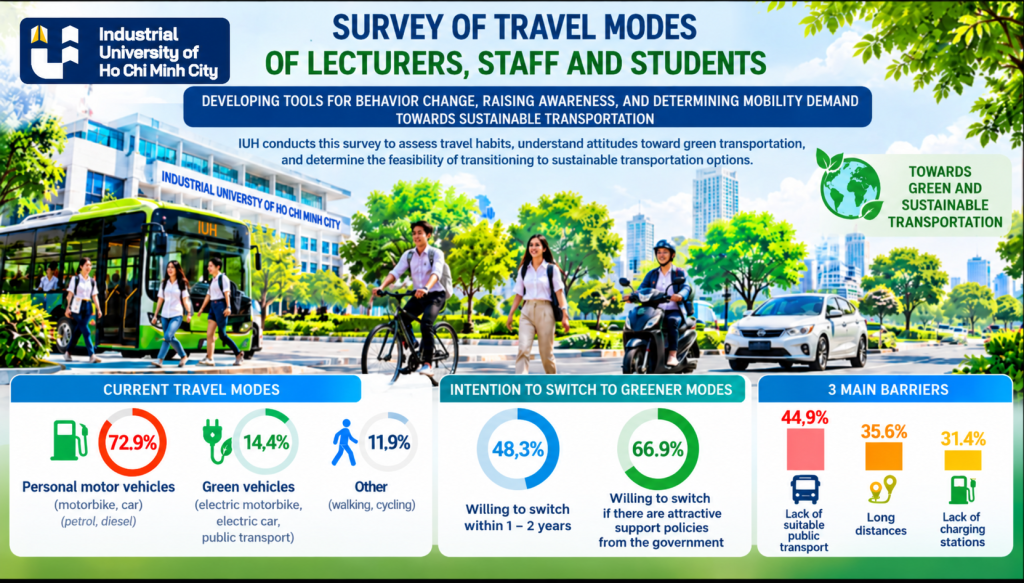
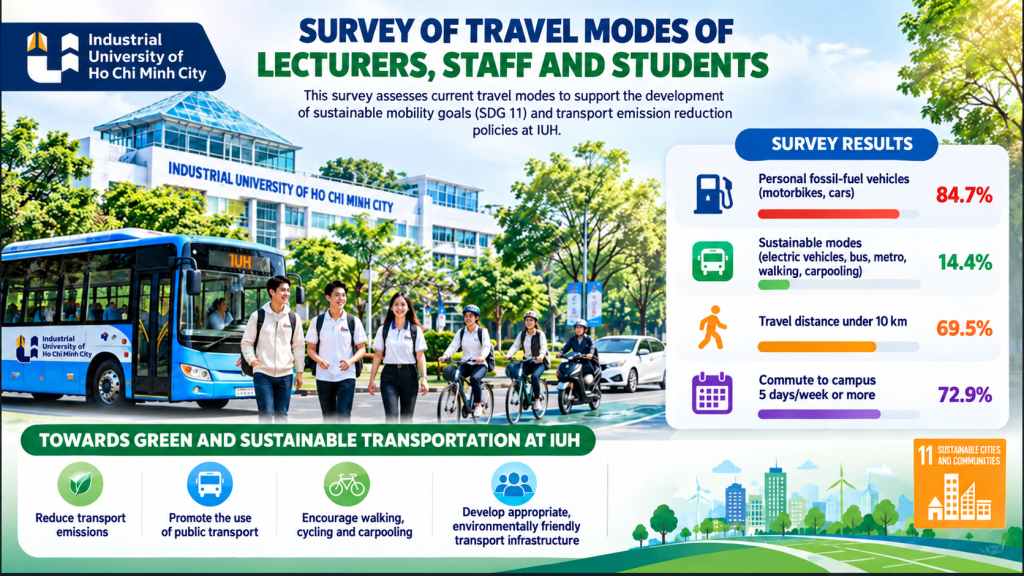
According to the consolidated results, 84.7% of respondents used private gasoline-powered vehicles, including 78.8% travelling by gasoline motorbike and 5.9% by gasoline car.
The reported share using sustainable transportation alternatives was 14.4%, covering electric vehicles, public buses, metro services, walking and carpooling.
The survey also found that 69.5% of participants travelled less than 10 kilometres to campus, while 72.9% commuted to the University at least five days per week.
These findings provide preliminary information about the concentration of commuting demand, the role of conventional private vehicles and potential opportunities to introduce alternative transport arrangements.
The relatively high share of gasoline-powered transportation among surveyed participants indicates that mobility-related environmental impacts are relevant to IUH’s broader sustainability planning.
Information about commuting distances can assist in examining the suitability of public transportation connections, shared mobility services and electric vehicles.
Similarly, the frequency of campus travel provides context for understanding how commuting choices may influence resource use over time.
The survey results represent the responses of the participating sample and should not automatically be interpreted as the transportation distribution of the University’s entire student and employee population.
To establish a representative institution-wide baseline, further analysis of sampling methods, respondent groups and campus coverage would be required.
By gathering preliminary commuting data, IUH has developed an initial information base for identifying mobility priorities and supporting future sustainable transportation planning.
Evidence link:
https://docs.google.com/forms/d/e/1FAIpQLScl8pacx5C_eW48ftdvriaC5tJ0GFvPlF4T5xJzBEgNrG7TUg/viewform
Activity 2: Measuring Environmental Awareness, Commuting Barriers and Willingness to Adopt Sustainable Transport
Promoting sustainable commuting requires an understanding not only of current transportation choices but also of the attitudes, barriers and motivations influencing travel behaviour.
IUH’s survey framework examined environmental awareness and the willingness of respondents to adopt more sustainable transportation alternatives.
According to the reported results, awareness of the environmental impacts of gasoline-powered vehicles was relatively high, with an average score of 4.03 out of 5 and 72.9% agreement on the relevant survey item.
However, only 48.3% of respondents indicated an intention to switch to greener transportation within the following one to two years without additional institutional support.
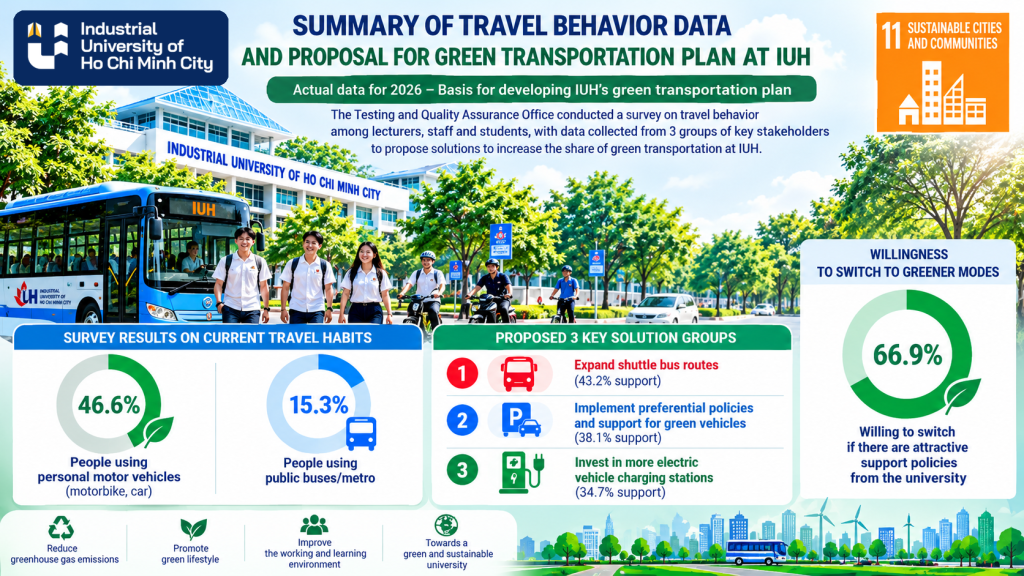
The survey also reported that willingness to change increased to 66.9% when supportive measures were considered, including incentives and shared transportation arrangements.
These findings suggest that environmental awareness alone may not be sufficient to encourage changes in commuting practices.
The assessment identified three frequently reported barriers:
- 44.9%: Lack of suitable public bus routes.
- 35.6%: Long commuting distances.
- 31.4%: Lack of safe electric vehicle charging facilities on campus.
These reported barriers highlight the importance of considering transportation accessibility, infrastructure and practical convenience when developing mobility initiatives.
For instance, improved connections to public transportation may reduce difficulties for commuters whose existing journeys are not adequately served by available routes.
Similarly, appropriate charging infrastructure may support individuals considering the adoption of electric vehicles.
Institutional incentives may also play a role in encouraging voluntary changes in transportation behaviour.
The survey provides useful information for identifying possible interventions and understanding the conditions under which participants may consider more sustainable commuting alternatives.
However, stated willingness to change is not equivalent to an actual shift in transportation behaviour. Follow-up measurements would be needed to evaluate whether implemented measures produce observable changes.
Through this assessment, IUH has established preliminary evidence relevant to designing sustainable mobility initiatives and identifying practical barriers to adoption.
Evidence link:
https://docs.google.com/forms/d/e/1FAIpQLScl8pacx5C_eW48ftdvriaC5tJ0GFvPlF4T5xJzBEgNrG7TUg/viewform
Activity 3: Consolidating Survey Findings and Proposing Sustainable Transportation Measures
Translating survey results into practical planning priorities is an important stage in developing sustainable transportation initiatives.
According to the supporting documentation, IUH’s System Management Centre prepared a consolidated report based on the 2026 commuting survey and proposed a set of measures for consideration by the University.
The report identified participants’ preferred transportation alternatives, including 46.6% who prioritized electric vehicles and 15.3% who selected public transportation, such as buses and metro services.
Based on these findings, the proposed approach focused on three groups of potential measures.
Developing Shared Transportation and Shuttle Services
The survey recorded 43.2% support for establishing or coordinating shuttle services.
Such services could provide additional transport options for commuters travelling along common routes and improve connectivity with public transportation networks.
Introducing Incentives for Sustainable Commuting
Approximately 38.1% of respondents supported incentives such as reduced parking fees for environmentally preferable transportation modes.
Incentive measures could be considered as part of a broader institutional approach to encouraging voluntary behavioural change.
Assessing Electric Vehicle Charging Infrastructure
The report recorded 34.7% support for installing safe electric vehicle charging facilities across University campuses.
Any future charging infrastructure initiative would require appropriate technical assessments, electrical safety considerations, location planning and operational arrangements.
Together, these three groups of proposed measures provide a preliminary framework for further analysis and institutional decision-making.
The consolidated findings can support the evaluation of feasibility, resource requirements and potential implementation priorities.
However, the measures identified in the report remain proposals. The available documentation does not establish that shuttle services, parking incentives or charging stations have been formally approved or implemented as part of this initiative.
The report also does not establish a formally approved numerical target for increasing the proportion of sustainable commuting.
By connecting survey findings with potential policy interventions, IUH is developing a foundation for future mobility planning and sustainable campus development.
Evidence link supplied in the dossier – verification required:
Results and Impact
IUH’s 2026 commuting assessment collected 118 valid survey responses and documented transportation choices, commuting distances, environmental awareness and barriers to adopting sustainable transport. Among respondents, 84.7% were reported to use private gasoline-powered vehicles, while 14.4% used transportation modes classified as sustainable in the survey. The findings also indicated that 66.9% expressed willingness to change commuting practices when supportive institutional measures were considered.
The consolidated assessment identified three potential directions for further planning: shuttle or shared transportation services, incentives for lower-emission commuting and safe electric vehicle charging infrastructure. These findings provide preliminary evidence for identifying mobility challenges and informing possible sustainability measures.
The work contributes to SDG 11 by developing an initial basis for sustainable commuting planning. Its value lies primarily in assessment and policy preparation rather than demonstrated changes in transportation behaviour or verified emission reductions. A representative institutional baseline, formally approved measurable targets and follow-up monitoring would be required to establish progress towards sustainable commuting objectives.
IUH khảo sát phương thức đi lại và xác định các giải pháp thúc đẩy giao thông bền vững
Giao thông bền vững đóng vai trò quan trọng trong việc giảm tác động môi trường từ hoạt động di chuyển hằng ngày, đồng thời góp phần phát triển hệ thống giao thông đô thị thân thiện với môi trường. Đối với cơ sở giáo dục đại học, việc tìm hiểu phương thức đi lại của sinh viên, giảng viên và viên chức là cơ sở để nhận diện nhu cầu, đánh giá rào cản và xây dựng các giải pháp phù hợp.
Trường Đại học Công nghiệp Thành phố Hồ Chí Minh (IUH) đã xây dựng phương thức tiếp cận dựa trên khảo sát để đánh giá đặc điểm di chuyển của cộng đồng đại học. Trong năm 2026, hồ sơ khảo sát ghi nhận thông tin về phương tiện sử dụng, quãng đường đi lại, nhận thức về môi trường và ý định chuyển đổi sang những phương thức giao thông bền vững hơn.
Kết quả khảo sát cung cấp dữ liệu ban đầu để Nhà trường xem xét các giải pháp như tổ chức phương tiện đưa đón, xây dựng chính sách khuyến khích sử dụng phương tiện phát thải thấp và nghiên cứu hạ tầng sạc xe điện.
Những hoạt động này phù hợp với định hướng của Mục tiêu phát triển bền vững số 11 (SDG 11) – Thành phố và cộng đồng bền vững, đặc biệt trong xây dựng cơ sở dữ liệu và hoạch định giải pháp giao thông bền vững.
Hoạt động 1: Khảo sát và đánh giá hiện trạng phương thức đi lại tại IUH
Tìm hiểu phương thức di chuyển hiện tại là bước đầu tiên để xác định những cơ hội thúc đẩy giao thông bền vững đối với sinh viên và nhân sự trong trường đại học.
Theo hồ sơ tổng hợp, IUH thực hiện khảo sát phương tiện đi lại của giảng viên, viên chức, người lao động và sinh viên, với 118 phản hồi hợp lệ.
Khảo sát tập trung vào loại phương tiện sử dụng, khoảng cách di chuyển và tần suất đến trường của người tham gia.
Kết quả ghi nhận 84,7% người trả lời sử dụng phương tiện cá nhân chạy xăng, trong đó xe máy xăng chiếm 78,8% và ô tô xăng chiếm 5,9%.
Nhóm phương thức được khảo sát phân loại là giao thông bền vững chiếm 14,4%, bao gồm phương tiện điện, xe buýt, metro, đi bộ và đi chung xe.
Bên cạnh đó, 69,5% người tham gia di chuyển dưới 10 km đến trường và 72,9% đến trường từ năm ngày mỗi tuần trở lên.
Những thông tin này cung cấp bức tranh ban đầu về nhu cầu di chuyển, mức độ sử dụng phương tiện cá nhân và khả năng xem xét các hình thức giao thông thay thế.
Tỷ lệ sử dụng phương tiện chạy xăng trong mẫu khảo sát cho thấy vấn đề phát thải liên quan đến giao thông là một nội dung cần được quan tâm trong hoạch định phát triển bền vững của IUH.
Dữ liệu về khoảng cách di chuyển giúp xem xét khả năng kết nối giao thông công cộng, dịch vụ đi chung phương tiện và các lựa chọn sử dụng xe điện.
Thông tin về số ngày đến trường cũng hỗ trợ đánh giá tần suất phát sinh nhu cầu giao thông, từ đó xác định những nhóm đối tượng có thể được ưu tiên trong các chương trình cải thiện.
Tuy nhiên, 118 phản hồi mới phản ánh đặc điểm của những người tham gia khảo sát, chưa thể tự xem là dữ liệu đại diện cho toàn bộ sinh viên, giảng viên và người lao động của IUH.
Để xác lập đường cơ sở toàn trường, cần tiếp tục xem xét phương pháp chọn mẫu, cơ cấu đối tượng và phạm vi các cơ sở được khảo sát.
Thông qua việc thu thập dữ liệu ban đầu, IUH hình thành cơ sở để nhận diện nhu cầu giao thông và phục vụ hoạt động nghiên cứu, xây dựng giải pháp di chuyển bền vững.
Nguồn minh chứng:
https://docs.google.com/forms/d/e/1FAIpQLScl8pacx5C_eW48ftdvriaC5tJ0GFvPlF4T5xJzBEgNrG7TUg/viewform
Hoạt động 2: Đo lường nhận thức, rào cản và ý định chuyển đổi sang phương tiện giao thông xanh
Thúc đẩy sử dụng giao thông bền vững không chỉ đòi hỏi nhận diện phương tiện hiện tại mà còn cần tìm hiểu nhận thức, động cơ và những khó khăn ảnh hưởng đến quyết định đi lại của người sử dụng.
Bộ công cụ khảo sát của IUH đề cập đến nhận thức môi trường và mức độ sẵn sàng chuyển đổi phương thức giao thông của người tham gia.
Theo báo cáo tổng hợp, mức độ nhận thức về tác động môi trường của phương tiện chạy xăng đạt điểm trung bình 4,03/5, với 72,9% người trả lời đồng ý ở nội dung khảo sát tương ứng.
Tuy nhiên, tỷ lệ có ý định tự chuyển đổi sang phương tiện xanh trong một đến hai năm tiếp theo chỉ đạt 48,3% khi chưa xét các chính sách hỗ trợ bổ sung.
Khi có những điều kiện hỗ trợ từ Nhà trường, khảo sát ghi nhận mức sẵn sàng chuyển đổi đạt 66,9%.
Sự khác biệt này cho thấy nhận thức về môi trường chưa nhất thiết dẫn đến thay đổi hành vi nếu người sử dụng chưa có điều kiện thuận tiện để lựa chọn phương tiện thay thế.
Ba rào cản được ghi nhận trong khảo sát gồm:
- 44,9%: Thiếu tuyến xe buýt phù hợp.
- 35,6%: Khoảng cách di chuyển xa.
- 31,4%: Thiếu hệ thống trạm sạc xe điện an toàn trong khuôn viên trường.
Những kết quả này cho thấy các giải pháp giao thông bền vững cần được xem xét từ góc độ khả năng tiếp cận, điều kiện hạ tầng và tính thuận tiện đối với người sử dụng.
Việc cải thiện kết nối xe buýt và phương tiện giao thông công cộng có thể giúp giảm khó khăn đối với người phải di chuyển qua những tuyến đường chưa được phục vụ phù hợp.
Trong khi đó, hệ thống sạc điện đáp ứng yêu cầu an toàn có thể tạo điều kiện thuận lợi hơn cho những người quan tâm đến việc sử dụng xe điện.
Các biện pháp khuyến khích phù hợp cũng có thể được nghiên cứu để hỗ trợ quá trình chuyển đổi hành vi một cách tự nguyện.
Thông qua khảo sát, IUH có thêm dữ liệu để xác định những yếu tố ảnh hưởng đến lựa chọn phương tiện và cân nhắc các chính sách có khả năng tác động đến nhu cầu thực tế.
Tuy nhiên, tỷ lệ sẵn sàng chuyển đổi là kết quả phản ánh ý định, không phải tỷ lệ người đã thực sự chuyển sang giao thông xanh. Để đánh giá kết quả triển khai, cần có khảo sát theo dõi sau khi các giải pháp được áp dụng.
Hoạt động góp phần hỗ trợ xây dựng chính sách dựa trên dữ liệu và nhận diện những điều kiện cần thiết nhằm thúc đẩy giao thông bền vững tại IUH.
Nguồn minh chứng:
https://docs.google.com/forms/d/e/1FAIpQLScl8pacx5C_eW48ftdvriaC5tJ0GFvPlF4T5xJzBEgNrG7TUg/viewform
Hoạt động 3: Tổng hợp kết quả khảo sát và đề xuất giải pháp giao thông xanh tại IUH
Chuyển hóa kết quả khảo sát thành những định hướng hành động là bước cần thiết để phát triển các sáng kiến giao thông bền vững có cơ sở thực tiễn.
Theo hồ sơ, Trung tâm Quản trị Hệ thống IUH đã tổng hợp dữ liệu khảo sát năm 2026 và đề xuất những nhóm giải pháp để Nhà trường tiếp tục xem xét.
Kết quả khảo sát ghi nhận 46,6% người tham gia ưu tiên lựa chọn xe điện, bao gồm xe máy điện, xe đạp điện và ô tô điện; trong khi 15,3% lựa chọn giao thông công cộng, như xe buýt và metro.
Từ những thông tin thu thập được, báo cáo đề xuất ba nhóm giải pháp.
Giải pháp 1: Nghiên cứu tổ chức phương tiện đưa đón và đi chung xe
Khảo sát ghi nhận 43,2% người tham gia ủng hộ phương án phối hợp tổ chức xe đưa đón.
Giải pháp có thể được xem xét đối với những tuyến đường có nhiều sinh viên hoặc người lao động cùng di chuyển, đồng thời hỗ trợ kết nối với mạng lưới giao thông công cộng.
Giải pháp 2: Xem xét cơ chế khuyến khích sử dụng phương tiện xanh
Có 38,1% người trả lời ủng hộ các biện pháp ưu đãi, chẳng hạn giảm phí gửi xe cho phương tiện đáp ứng tiêu chí giao thông xanh.
Những biện pháp này có thể được nghiên cứu trong khuôn khổ chính sách khuyến khích thay đổi hành vi đi lại và sử dụng phương tiện phát thải thấp.
Giải pháp 3: Đánh giá khả năng đầu tư hệ thống trạm sạc xe điện an toàn
Khảo sát ghi nhận 34,7% người tham gia ủng hộ phương án lắp đặt trạm sạc xe điện tại các cơ sở của Nhà trường.
Nếu được nghiên cứu triển khai, giải pháp cần có đánh giá kỹ thuật, an toàn điện, lựa chọn vị trí, khả năng đáp ứng công suất và phương án quản lý vận hành.
Ba nhóm giải pháp trên hình thành khung đề xuất ban đầu để Nhà trường tiếp tục đánh giá tính khả thi, nguồn lực đầu tư và thứ tự ưu tiên.
Tuy nhiên, đây là những phương án được đề xuất từ kết quả khảo sát, chưa có căn cứ xác nhận đã được cấp có thẩm quyền phê duyệt hoặc tổ chức triển khai.
Hồ sơ cũng chưa thể hiện một mục tiêu định lượng chính thức, chẳng hạn tỷ lệ sử dụng giao thông bền vững phải đạt vào một năm cụ thể.
Việc tổng hợp khảo sát và đề xuất giải pháp tạo cơ sở để IUH phát triển hoạt động hoạch định giao thông xanh dựa trên dữ liệu và nhu cầu của cộng đồng đại học.
Đường dẫn được cung cấp trong hồ sơ – cần thay bằng minh chứng chính thức:
Kết quả và tác động
Trong năm 2026, hồ sơ khảo sát của IUH ghi nhận 118 phản hồi hợp lệ, cung cấp thông tin về phương tiện đi lại, quãng đường di chuyển, nhận thức và những rào cản đối với việc lựa chọn giao thông bền vững. Theo báo cáo tổng hợp, 84,7% người tham gia sử dụng phương tiện cá nhân chạy xăng và 14,4% thuộc nhóm phương thức được phân loại là bền vững. Đáng chú ý, 66,9% người tham gia bày tỏ sự sẵn sàng chuyển đổi khi có những chính sách hỗ trợ phù hợp.
Trên cơ sở đó, hồ sơ đề xuất ba hướng giải pháp gồm tổ chức phương tiện đưa đón hoặc đi chung xe, áp dụng ưu đãi đối với phương tiện xanh và nghiên cứu lắp đặt hệ thống trạm sạc xe điện an toàn. Những kết quả này cung cấp thông tin ban đầu để Nhà trường nhận diện rào cản và xem xét các ưu tiên trong hoạch định giao thông bền vững.
Đóng góp của hoạt động đối với SDG 11 thể hiện ở việc phát triển cơ sở dữ liệu ban đầu và đề xuất giải pháp phù hợp với nhu cầu người sử dụng. Tuy nhiên, đây vẫn là kết quả khảo sát và chuẩn bị chính sách, chưa phải bằng chứng cho thấy tỷ lệ sử dụng phương tiện xanh đã tăng hoặc phát thải khí nhà kính đã giảm. Để theo dõi tiến độ thực hiện mục tiêu, IUH cần tiếp tục hoàn thiện dữ liệu đại diện toàn trường, ban hành các chỉ tiêu định lượng và thiết lập cơ chế đánh giá định kỳ.


